September 26, 2026 - 7:30 p.m.
Kodály’s Dances of Galánta launches the program with rhythmic bite and radiant color, followed by Strauss’ Horn Concerto No. 1. Elgar’s Enigma Variations concludes with sharply etched musical portraits and a commanding orchestral finish.
Program
Alastair Willis, conductor
Kurt Civilette, horn
ZOLTÁN KODÁLY
Dances of Galánta
RICHARD STRAUSS
Horn Concerto No. 1 in E-flat Major, Op. 11
EDWARD ELGAR
Variations on an Original Theme, Op. 36, “Enigma”
Dances of Galánta
Zoltán Kodály
Born: December 16, 1882,
Kecskemét, Hungary
Died: March 6, 1967, Budapest, Hungary
Composed: 1933
Premiered: October 23, 1933, Budapest, by the Budapest Philharmonic Society Orchestra, Ernő Dohnányi conducting
Length: 16 minutes
For Zoltán Kodály, Hungary’s musical identity was not an abstract idea. It was something tangible, something he directly studied and heard. As a child, he spent seven formative years in Galánta, a market town on the railway between Budapest and Vienna, now located in modern day Slovakia. His father served as the town’s stationmaster, and the young Kodály encountered performances of Galánta’s celebrated local ensemble.
Kodály later joined Béla Bartók in studying and preserving the traditional music of Hungary and its neighboring regions. Their work helped transform the way composers understood folk music. Not as a “light music,” but rather a rich musical language worthy of close attention and study. Dances of Galánta, however, did not grow directly from Kodály’s fieldwork. For its principal themes, he turned to collections of Hungarian dances published in Vienna around 1800, preserving melodies directly associated with musicians from Galánta.
The Budapest Philharmonic Society commissioned the work in 1933 to celebrate its 80th Anniversary. The music draws on the broad tradition of verbunkos, a Hungarian dance tradition associated with military recruitment. Verbunkos typically contrasts a stately slow section, or lassú, with a spirited fast section, or friss. Historically, such dances accompanied military recruitment displays, using music and movement to make a soldier’s life appear irresistible.
Dances of Galánta begins with a broad, arresting gesture in the low strings. From this introduction, a solo clarinet emerges in an improvisatory cadenza, establishing the instrument as one of the work’s distinctive voices. A noble Andante follows, its flexible rhythms and ornamented melody suggesting the freedom and fluidity of a folk performance. Gradually, the pace quickens. New dances enter in succession, each with its own rhythmic profile and character, while returns of the slower music give the single-movement work form and continuity.
Kodály saves his most dazzling writing for the close. Woodwinds trade bright and agile phrases while strings drive the rhythm forward; bursts of percussion brighten the orchestral fabric. A sudden pause seems to halt the celebration only for the full ensemble to race into an exhilarating final flourish. In Dances of Galánta, history, artistry, and memory meet to form a timeless work which defines both the folk and classical traditions to this day.
Horn Concerto No. 1 in E-flat Major, Op. 11
RICHARD STRAUSS
Born: June 11, 1864, Munich, Germany
Died: September 8, 1949,
Garmisch-Partenkirchen, Germany
Composed: 1882–83
Premiered: March 4, 1885, Meiningen, Germany, with Gustav Leinhos as soloist and Hans von Bülow conducting
Length: 16 minutes
After a single emphatic chord from the orchestra, the solo horn enters with a fearless fanfare. There are no leisurely introductions and no time to settle in, Richard Strauss places the soloist at the center of the music immediately. The gesture makes a fitting opening to a concerto that tests every aspect of the instrument while celebrating its many sounds and moods.
Strauss wrote his Horn Concerto No. 1 from 1882 to 1883 he was only eighteen years old. Although he had not yet developed the expansive harmonic language of his later tone poems and operas, he already possessed an instinctive understanding of the orchestra. That understanding began at home. His father, Franz Strauss, was the celebrated principal horn of the Munich Court Opera, and Richard grew up surrounded by professional musicians. He knew both what the horn did naturally and what was possible when pushed beyond comfortable limits.
The concerto unfolds in three connected movements. The orchestra develops this energetic material before the soloist reveals another side of the instrument in a broad, gracefully shaped melody. These contrasting ideas, both commanding and tender, establish the concerto’s expressive range.
Without a full stop, the first movement recedes into the Andante. Here the atmosphere darkens, and the horn sings against a restrained orchestral background. Strauss subtly reshapes ideas heard earlier, allowing the slow movement to feel both new and familiar. Another seamless transition leads into the finale, where the opening fanfare is reborn as a buoyant, quick-moving theme. Hunting-call figures, agile leaps, and sweeping phrases propel the music toward its jubilant close.
Strauss originally titled the orchestral score for Waldhorn, or natural horn, the valveless instrument his father favored even as valved horns became increasingly common. Modern performers use the valved horn, but the concerto remains a formidable test of range, breath, accuracy, and endurance.
Variations on an Original Theme, Op. 36 (“Enigma”)
Edward Elgar
Born: June 2, 1857, Lower Broadheath, near Worcester, England
Died: February 23, 1934, Worcester, England
Composed: 1898–99
Premiered: June 19, 1899, St. James’s Hall, London, Hans Richter conducting
Length: 31 minutes
One evening in October 1898, Edward Elgar returned home weary from a long day of teaching and sat down at the piano. As he improvised, his wife Alice was drawn to a quiet, searching melody. Elgar began reshaping it for her amusement, imagining how various friends might play, or compose, the tune themselves. What began as an affectionate private game soon became Variations on an Original Theme, the work that transformed his public career.
Elgar dedicated the score to the friends portrayed within it. Most variations carry initials or nicknames rather than full names, but the identities were known within his circle. “C.A.E.” is a tender expansion of the theme for Alice, his closest companion and strongest advocate. “Ysobel” features the viola in recognition of his student Isabel Fitton, while the unruly rhythms of “Troyte” evoke architect Arthur Troyte Griffith’s enthusiastic but unpolished piano playing. “G.R.S.” nominally honors organist George Robertson Sinclair, though its splashing music depicts Sinclair’s bulldog Dan scrambling from the River Wye.
At the emotional center stands “Nimrod,” Elgar’s portrait of his publisher and confidant August Jaeger. Jaeger’s surname means “hunter” in German, inspiring the reference to the biblical hunter Nimrod. The music’s gradual rise from restraint to glowing intensity has made “Nimrod” the best-known variation and a work frequently heard at memorials.
The final portrait, “E.D.U.,” represents Elgar himself through Alice’s nickname for him. Music associated with Alice and Jaeger returns, surrounding the composer with the voices of those who sustained him. The conclusion turns the theme’s uncertainty into confidence and celebration.
The friends were identifiable; the true “enigma” was not. Elgar suggested that another, larger idea passes through the entire work without ever being heard directly. Proposed solutions have ranged from familiar melodies to literary and philosophical concepts, but none has been proven. Friendship itself may be the most persuasive answer, even if it cannot be demonstrated musically.
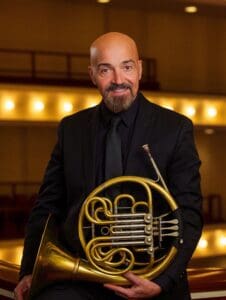
Kurt Civilette has been Principal Horn with South Bend Symphony Orchestra since 2012. He last appeared as a featured soloist in May, 2018, performing the Schumann Konzertstuck for 4 horns and orchestra with the rest of the South Bend Symphony section. He recently was featured soloist with Midland Symphony in March, 2026, finally realizing a long-time dream of performing the Reinhold Gliere horn concerto.
Originally from Buffalo, NY, Kurt earned a bachelor of music in horn performance at Northwestern University. Currently he is a freelance performer based in Lansing, MI, holding 5 permanent positions in the area including principal horn with SBSO and Midland(MI) Symphony and 3rd horn in Flint Symphony, Ann Arbor Symphony, and Traverse City Philharmonic. He is frequently asked to play guest principal. In past freelance work he has played extra with Detroit, St Louis, Utah, Toledo Symphonies, as well as Santa Fe Opera, Lyric Opera of Chicago and Michigan Opera Theater.
For 15 years from 1995-2010, Kurt was full-time 3rd horn/associate principal with New Mexico Symphony in Albuquerque, and was also 3rd horn of the Santa Fe Symphony.
During the summers, Kurt plays principal horn with the Southern Illinois Music festival in Carbondale and the Baroque on Beaver Festival on Beaver Island(MI).
Outside of music, Kurt is an avid runner and just completed the 50 state marathon challenge, running his 50th state in the 50th state, in Maui, January 2026.
The Jack M. Champaigne Masterworks Series is proudly sponsored by