
Carlos Simon’s The Block opens with striking presence, followed by the sweep and drama of Rachmaninoff’s Piano Concerto No. 2. Mussorgsky’s Pictures at an Exhibition closes with rich scenes, framed by the “Promenade,” and a monumental ending with “Great Gate of Kyiv.”
Program
Alastair Willis, conductor
Stewart Goodyear, piano
Carlos SIMON
The Block
SERGEI RACHMANINOV
Piano Concerto No. 2 in C minor
Intermission
MODEST MUSSORGSKY
Pictures at an Exhibition
Composer Key: Composer names in ALL CAPS indicate deceased composers. Composer names in Title Case indicate living composers.
Calendar for Pictures at an Exhibition
The Block
Carlos Simon
“The Block” is a short orchestral study based on the late visual art of Romare Bearden. Most of Bearden’s work reflects African American culture in urban cities as well as the rural American south. Although Bearden was born in Charlotte, North Carolina, he spent his most of his life in Harlem, New York. With its vibrant artistic community, this piece aims to highlight the rich energy and joyous sceneries that Harlem expressed as it was the hotbed for African American culture.
The Block is comprised of six paintings that highlight different buildings (church, barbershop, nightclub, etc.) in Harlem on one block. Bearden’s paintings incorporate various mediums including watercolors, graphite, and metallic papers. In the same way, this musical piece explores various musical textures which highlight the vibrant scenery and energy that a block on Harlem or any urban city exhibits.
— Carlos Simon
Piano Concerto No. 2
in C minor, Op. 18
Sergei Rachmaninoff
Born: April 1, 1873, Oneg estate near Novgorod, Russia
Died: March 28, 1943, Beverly Hills, California
Composed: 1900–1901
Premiered: November 9, 1901, Moscow; Rachmaninoff as soloist and Alexander Siloti conducting
Length: 35 minutes
In March 1897, the disastrous premiere of Sergei Rachmaninoff’s First Symphony dealt a major blow to the young composer’s confidence. Harsh reviews intensified a period of depression and creative paralysis, and for several years he found substantial composition almost impossible. Eventually his family encouraged him to consult the Moscow physician Nikolai Dahl, whose treatment combined psychotherapy, hypnosis, and repeated assurances that Rachmaninoff would write a successful concerto. Whatever combination of treatment, rest, and renewed determination restored him, his music began to return.
Rachmaninoff completed the second and third movements of his new concerto first, performing them in December 1900. He finished the opening movement the following spring, and the complete work received an enthusiastic Moscow premiere in November 1901, with Rachmaninoff as soloist and his cousin Alexander Siloti conducting. In gratitude, he dedicated the score to Dahl. The concerto’s success helped reestablish his reputation as a composer and transformed a period of profound uncertainty into one of music’s most celebrated stories of creative renewal.
The opening Moderato begins with the piano alone, sounding a sequence of chords which toll like distant bells drawing steadily nearer. The orchestra then enters with a broad, dark melody while the soloist supplies surging arpeggios beneath it. A tender second theme reveals Rachmaninoff’s extraordinary gift for long-spun melody. Piano and orchestra exchange roles throughout: one carries the song while the other supplies motion, color, and momentum.
Muted strings open the Adagio sostenuto, easing the music from C minor into the luminous distance of E major. Over the piano’s gently rippling accompaniment, flute and then clarinet introduce an intimate melody. The soloist gradually takes possession of it, leading the movement through an agitated central episode before tranquility returns.
The finale begins with nervous, march-like energy, but soon yields to another expansive melody, first heard in the viola and oboe. Rachmaninoff delays its fullest realization, allowing brilliance and lyricism to compete until the melody finally returns in a sweeping C-major transformation. The concerto’s journey from tolling C-minor darkness to this radiant conclusion could be said to suggest triumph over adversity. Yet its lasting power rests not only in biography, but in its balance: formidable virtuosity joined to tenderness, memorable melody shaped by firm design, and a soloist who triumphs with the orchestra.
Pictures at an Exhibition
Modest Mussorgsky
Born: March 21, 1839, Karevo, Russia
Died: March 28, 1881, St. Petersburg, Russia
Composed: 1874, originally for solo piano
Orchestrated: 1922 by Maurice Ravel (1875–1937)
Premiered: October 19, 1922, Paris Opera; Serge Koussevitzky conducting the Ravel orchestration
Length: 30 minutes
When architect and artist Viktor Hartmann died suddenly in 1873, Modest Mussorgsky lost a close friend and fellow advocate for a Russian art. The following year, critic Vladimir Stasov organized a memorial exhibition in St. Petersburg, assembling hundreds of Hartmann’s drawings, watercolors, designs, and architectural studies. Mussorgsky responded with a memorial of his own: a piano suite completed in a burst of inspiration during the following summer.
Pictures at an Exhibition is more than a musical catalogue. Its recurring “Promenade” places Mussorgsky himself inside the work, walking from one image to the next. The theme changes with each return; sometimes confident, sometimes thoughtful, eventually shadowed by grief almost as if the viewer’s response to the exhibition is becoming intertwined with the exhibition itself.
The pictures range freely between humor, fantasy, portraiture, and the grandiose. “Gnomus” depicts a grotesque nutcracker lurching on crooked legs. “The Old Castle” imagines a troubadour singing before a medieval ruin, while “Tuileries” catches children quarreling in a Paris garden. A heavy Polish oxcart passes in “Bydło,” followed by the comic delicacy of chicks dancing in their shells. Two sharply contrasted personalities confront one another in “Samuel Goldenberg and Schmuÿle,” and the marketplace at Limoges erupts in breathless chatter.
The suite then turns toward darkness. In “Catacombs,” Hartmann explores the tunnels beneath Paris by lantern light. Mussorgsky transforms the Promenade into “Cum mortuis in lingua mortua,” with the dead in a dead language, as if communing with his departed friend. From this stillness bursts Baba-Yaga, the fearsome witch of Slavic folklore, racing through the air before the suite arrives at “The Great Gate of Kyiv.” Hartmann’s design for the gate was never built, but Mussorgsky realizes it in sound through ceremonial hymns, pealing bells, and the triumphant return of the Promenade.
Mussorgsky wrote the suite for piano and never orchestrated it himself. However, nearly half a century later the great conductor Serge Koussevitzky commissioned Maurice Ravel to do so. Ravel’s 1922 version draws extraordinary colors from the orchestra. The lonely alto saxophone of “The Old Castle,” the muttering low brass of “Bydło,” and the blazing bells of the finale without diminishing Mussorgsky’s bold outlines. Their combined achievement turns one artist’s memorial exhibition into a vivid encounter among painting, memory, and sound.
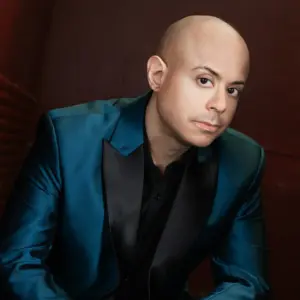
About Stewart Goodyear
Pianist and composer Stewart Goodyear is acclaimed for his virtuosity, imagination, and wide-ranging musical voice. His original works include Callaloo, a suite for piano and orchestra inspired by the cultural traditions of his Trinidadian heritage, as well as commissions for orchestra, chamber ensemble, and solo instrument. His transcription of Tchaikovsky’s complete Nutcracker for solo piano was named one of the best classical recordings of 2015 by The New York Times.
A celebrated Beethoven interpreter, Goodyear has performed all 32 piano sonatas in a single day and recorded both the complete sonatas and concertos. The New York Times praised his Beethoven cycle as “a remarkable achievement,” highlighting his “pristine technique, infectious energy and fascinating attention to detail.”
Goodyear has appeared with the New York Philharmonic, Chicago Symphony Orchestra, Philadelphia Orchestra, Cleveland Orchestra, Los Angeles Philharmonic, and San Francisco Symphony, among many others. His discography includes works by Beethoven, Tchaikovsky, Grieg, Rachmaninoff, and Ravel.
He studied at Toronto’s Glenn Gould School, the Curtis Institute of Music, and the Juilliard School. During the current season, Goodyear performs with orchestras across North America, including the South Bend Symphony Orchestra, while continuing his work as a recitalist, recording artist, and composer.
The Jack M. Champaigne Masterworks Series is proudly sponsored by