Mahler’s Symphony No. 2, “Resurrection” unfolds in one great, uninterrupted arc, building from a dramatic opening to an ending with soloists, Alisa Jordheim and Gabby Beteag, and chorus!
Program
Alastair Willis, conductor
Alisa Jordheim, soprano
Gabby Beteag, mezzo
GUSTAV MAHLER
Symphony No. 2
Calendar for Mahler’s Symphony No. 2
Symphony No. 2 in C minor, “Resurrection”
Gustav Mahler
Born: July 7, 1860, Kalischt, Bohemia, Austrian Empire, now Kaliště,
Czech Republic
Died: May 18, 1911, Vienna, Austria
Composed: 1888–1894;
revised through 1903
Premiered: December 13, 1895, Berlin; Mahler conducting
Length: 80 minutes
Vocal forces: Soprano, mezzo-soprano, and mixed chorus
“Why have you lived? Why have you suffered? Is all this merely a great, horrible jest?” — Gustav Mahler, describing his Second Symphony in a letter to the critic Max Marschalk, March 26, 1896.
Mahler did not pose those questions rhetorically. His Second Symphony subjects them to an eighty-minute gauntlet, traveling from a funeral march in C minor to a vision of resurrection in E-flat major. The destination may be radiant, but Mahler refuses to reach it cheaply. Memory, irony, doubt, terror, prayer, and silence all must to be traversed first.
The symphony began in 1888 as Totenfeier, “Funeral Rites,” a vast symphonic poem that became its first movement. Mahler later described it as the burial of the hero of his First Symphony. When he played it for the eminent conductor Hans von Bülow in 1891, Bülow reacted with bewilderment, and Mahler set the project aside. He returned to it in 1893, composing the second and third movements and drawing “Urlicht” from his settings of the folk-poetry collection Des Knaben Wunderhorn. Yet he still lacked a finale capable of answering the first movement.
The solution arrived at Bülow’s funeral in 1894. A choir sang Friedrich Gottlieb Klopstock’s resurrection hymn, and its opening words struck Mahler as the answer he had been seeking. He used two of Klopstock’s stanzas, added verses of his own, and completed the symphony that summer. After a partial performance conducted by Richard Strauss, Mahler led the complete premiere in Berlin in December 1895.
The performing forces announce the scale of Mahler’s ambition. Expanded woodwinds and brass, a large percussion battery, two harps, organ, an offstage ensemble, two vocal soloists, and mixed chorus. Yet size is only one of his expressive tools. Some of the symphony’s most overwhelming passages emerge from smaller, chamber-like textures, distant sounds, or near total silence.
The first movement begins with a violent tremor in the lower strings. A grim funeral march takes shape, repeatedly challenged by lyrical glimpses of warmth and by distant suggestions of the music’s eventual resurrection. The scale is enormous, yet the argument remains concentrated: death advances, consolation answers, and catastrophe repeatedly breaks through. Mahler requires a substantial pause afterward, allowing its questions to hang in the air.
The Andante moderato looks backward. Its graceful Ländler, an Austrian country dance, suggests a cherished memory from the life now ended. Delicate string playing and a flowing cello countermelody preserve the movement’s poise, though agitated episodes disturb the recollection. The third movement turns dance into a disorienting mechanism. Based on Mahler’s song about St. Anthony preaching to fish who listen politely and then resume their old behavior. The scherzo circles with sardonic energy until a tremendous orchestral cry tears through its surface.
Human speech finally enters in “Urlicht,” or “Primal Light.” The mezzo-soprano sings a simple Wunderhorn prayer: humanity lies in suffering, yet a small divine light will lead the soul toward blessed life. Its quiet certainty forms the spiritual hinge of the symphony.
The finale shatters that stillness with the scherzo’s cry of despair. Earlier ideas return amid marches, fanfares, offstage brass, and apocalyptic percussion. Then comes a remarkable clearing: distant calls sound across an emptied landscape, birdlike flute and piccolo figures hover above the silence, and the chorus enters almost inaudibly with the promise, “Rise again.” Mahler gradually joins chorus, soprano, mezzo-soprano, orchestra, organ, and bells in an affirmation of his own making: nothing loved or struggled for has been lost; death will become the passage into life.
Mahler later withdrew the detailed programs he had supplied for the symphony, preferring listeners to find their own way through it. That freedom matters. The Second need not prescribe a single theology to convey its central conviction.
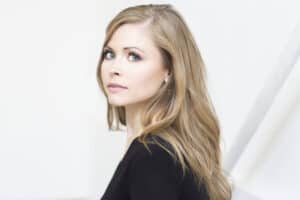
Photo by Fay Fox
Described as “vocally resplendent,” “powerful,” and possessing “impeccable coloratura” (San Francisco Chronicle), versatile soprano Alisa Jordheim is praised for her compelling and vocally assured performances in opera, concert, musical theatre, new music, early music, and recital. Ms. Jordheim’s recent portrayal of Soeur Constance in Dialogues des Carmélites at the Caramoor International Music Festival was met with great acclaim: Sister Constance was “beautifully taken here by the sweet-voiced, endearing soprano Alisa Jordheim” (The New York Times) and “winningly performed by Alisa Jordheim in a soprano of surprising depth and color” (Musical America). Of her recent triumph as Gilda in Rigoletto with San Diego Opera, the San Diego Union-Tribune writes: “Soprano Alisa Jordheim makes an astonishing role and company debut as Gilda. Despite her petite size, she has a huge crystalline voice that she effortlessly pirouettes through perfect coloratura acrobatic and piercing high notes.” Ms. Jordheim was recently named an outstanding young singer to watch in “40 under 40: A New Generation of Superb Opera Singers,” an article curated by Operavor and WQXR New York Public Radio.
In the 2025-2026 season, Ms. Jordheim makes her role debut as Liù in Turandot in a return to the Pacific Symphony, and also sings concerts with the New York Opera Society, Cincinnati Song Initiative, New Philharmonic, Present Music, and Milwaukee Musaik. Last season, Ms. Jordheim made several exciting role debuts, including Violetta in La Traviata with Opera Western Reserve, Adina in L’elisir d’amore with the New Philharmonic, La Fée in Cendrillon with Opera Orlando, Daria/Prima Donna in Donizetti’s Viva la Mamma with Florentine Opera, and the Young Girl in Cipullo’s After Life with Music of Remembrance in Seattle and San Francisco, in addition to joining San Francisco Opera to cover Oscar in Un ballo in maschera and Janine/Ofwarren in The Handmaid’s Tale. She also performed Carmina Burana with both the Pacific Symphony and Evansville Philharmonic, holiday concerts with San Diego Opera and the Spreckels Organ Society, and an “Iconic Broadway” concert with the Northwest Indiana Symphony.

Photo by Lola Scott
American mezzo Gabrielle Beteag brings a fresh joy and commanding warmth to stages across the United States and beyond. Endlessly inspired by the challenges inherent in developing new works, Beteag counts her role creation of Iras in John Adams’ Antony and Cleopatra during San Francisco Opera’s Centennial Season as a career highlight. Other recent performances at SFO include Mother in The Handmaid’s Tale, Teacher in The (R)evolution of Steve Jobs, Stimme von oben in Die Frau ohne Schatten, and an Image of Frida Kahlo in El último sueño de Frida y Diego. Beteag was also recently seen as Gertrude Stein in Tom Cipullo’s After Life with Music of Remembrance and Anna I in Kurt Weill’s Seven Deadly Sins with the Hilton Head Symphony Orchestra.
A lover of concert work, Beteag has collaborated with ensembles including the Cabrillo Festival Orchestra, the National Symphony
Orchestra, the Santa Rosa Symphony, the San Francisco Ballet, and the National Orchestral Institute + Festival, where she sang Mahler’s Resurrection Symphony under Marin Alsop’s baton.
Beteag, achieving a lifelong dream, was named a Grand Finals Winner of the Metropolitan Opera National Council Auditions (now the Laffont Competition) in 2020. Other industry accolades include prizes from the Gerda Lissner Foundation (Grant Winner, 2025), the Paris Opera Competition (Finalist, 2025), the Giulio Gari Foundation (Third Place, 2024), Operalia (Semifinalist, 2023), the Cooper-Bing Competition at Opera Columbus (First Place, 2023), and the Shreveport Opera Mary Jacobs Singer of the Year Competition (Second Place, 2020).
Beteag’s 2026 season includes concerts with the Roswell Music Club and Lieder Alive!, a house debut at Opera Roanoke, and returns to the Santa Rosa Symphony and San Francisco Opera.
While offstage, Beteag enjoys spending time with her husband, Tim, and receiving the best vocal coaching around from their hound dogs, Hambone and Persephone.
The South Bend Chamber Singers, an ensemble-in-residence at Saint Mary’s College under the direction of Nancy Menk, is in its 28th season. Over the past 20-plus years the Singers have presented major choral-orchestral works such as Handel’s Messiah, Bach’s Magnificat, B Minor Mass, and St. John Passion; Mendelssohn’s Elijah, Vivaldi’s Gloria, Haydn’s Lord Nelson Mass, Brahms’ Requiem and Orff’s Carmina Burana. Yet, the ensemble concentrates primarily on works by living composers and regularly commissions new works and unusual and complex arrangements.
The Singers have commissioned new choral works from composers Stephen Paulus, Jan Bach, William Hawley, Steven Sametz, Libby Larsen, Gregg Smith, Carey Boyce, Frank Ferko, Dan Locklair, Carol Barnett, Paul Carey, Zae Munn, Robert Harris, J. David Moore, and many others, most of which have been published and continue to be performed by choirs throughout the world. Other concerts have featured music from the United States, Canada, South America, Europe, Africa, India, Korea, and even Mongolia.
The choir has joined with numerous other chamber and instrumental ensembles including the South Bend Symphony Orchestra, the Chicago Chamber Orchestra, and Germany’s Chamber Orchestra of the Rhine; the Chester, Cavani, and Avalon String Quartets; the Northern Illinois University Steel Band, and South Bend’s own Kennedy’s Kitchen.
The Chamber Singers were selected to perform for the Central Division Convention of the American Choral Directors Association in 1996 (Cincinnati) and 2002 (Chicago). In 2000, the Singers were one of five finalists for the prestigious Margaret Hillis Award for Choral Excellence, given annually by Chorus America, and they won the ASCAP/Chorus America Award for Adventurous Programming in 2004. In March 2012 they performed for the American Choral Directors Association Central Division Conference in Fort Wayne. They were semi-finalists for The American Prize in Choral Performance in 2012 and 2013. From 1992 to 2009 they were awarded annual grants from the Indiana Arts Commission.
The Jack M. Champaigne Masterworks Series is proudly sponsored by