The evening opens with sharp brass and fast-moving momentum from Wagner’s Die Meistersinger Overture, followed by Anna Clyne’s Glasslands, a vivid saxophone performance. Brahms’ Symphony No. 4 delivers drama and a propulsive conclusion.
Program
Alastair Willis, conductor
Timothy McAllister, saxaphone
RICHARD WAGNER
Die Meistersinger Overture
Anna CLYNE
Glasslands, Concerto for Soprano Saxophone
Intermission
JOHANNES BRAHMS
Symphony No. 4
Composer Key: Composer names in ALL CAPS indicate deceased composers. Composer names in Title Case indicate living composers.
Calendar for Brahms' Symphony No. 4
Prelude to Die Meistersinger
von Nürnberg
Richard Wagner
Born: May 22, 1813, Leipzig, Germany
Died: February 13, 1883, Venice, Italy
Composed: 1862
Premiered: November 1, 1862, Gewandhaus, Leipzig, Wagner conducting
Length: 10 minutes
Among Richard Wagner’s mature music dramas, Die Meistersinger von Nürnberg is an exception to his normal subject matter. Rather than gods, legendary heroes, or doomed lovers, it presents a comedy populated by the tradespeople of 16th-Century Nuremberg. Its central question, however, was close to Wagner’s heart: how can an artistic tradition remain alive without becoming trapped by its own rules?
The mastersingers were German craftsmen who composed poetry and song under strict rules from the 14th through the 16th Centuries. Wagner’s story centers on Walther von Stolzing, a young knight who hopes to win both a song contest and the hand of Eva Pogner, a beautiful goldsmith’s daughter. Walther’s music violates the guild’s established standards, but a wise cobbler-poet named Hans Sachs recognizes genuine inspiration beneath its unconventional form. The conflict between Walther’s creativity and the guild’s conservatism drives the opera toward a reconciliation of innovation and tradition.
Wagner first considered the subject in 1845 but set it aside while completing other enormous projects, including Lohengrin, Tristan und Isolde, and portions of the Ring cycle. He returned to Die Meistersinger in 1861 and completed the Act I Prelude in March 1862, before composing the rest of the opera. Wagner introduced the Prelude as a concert work in Leipzig later that year; the complete opera did not reach the stage until 1868.
The Prelude opens with the mastersingers’ broad, ceremonial theme, presented by the full orchestra with the dignity of a public procession. A second stately idea reinforces the authority and tradition of the guild. Wagner then offers a lyrical contrast with music connected with Walther’s prize song and his love for Eva. The atmosphere becomes lighter as quick figures introduce the mastersingers’ apprentices, whose bustling energy develops into a fugue.
That old-fashioned contrapuntal technique is no mere historical decoration. At the climax, Wagner layers the mastersingers’ ceremonial music, Walther’s soaring melody, and the apprentices’ lively theme so that they sound simultaneously. Order and freedom, discipline and imagination, do not destroy one another; they combine to create something richer.
The result is both a compact summary of the opera and an orchestral argument about art. Wagner’s magnificent closing pages celebrate tradition while demonstrating that its greatest strength lies in its ability to welcome a compelling new voice.
Glasslands Concerto for Soprano Saxophone and Orchestra
Anna Clyne
Glasslands conjures an imaginary world of three realms governed by the banshee – a female spirit who, in Irish folklore, heralds the death of a family member, usually by wailing, shrieking, or keening in the silence of the night.
— Anna Clyne
Symphony No. 4 in
E minor, Op. 98
Johannes Brahms
Born: May 7, 1833, Hamburg, Germany
Died: April 3, 1897, Vienna, Austria
Composed: 1884–1885,
Mürzzuschlag, Austria
Premiered: October 25, 1885, Meiningen, Germany; Brahms conducting the Meiningen Court Orchestra
Length: 40 minutes
Johannes Brahms spent the summers of 1884 and 1885 in Mürzzuschlag, a mountain town southwest of Vienna, where he composed what would prove to be his final symphony. By then, the long shadow of Beethoven that had made Brahms so cautious about entering the symphonic arena no longer seemed as intimidating. In the Fourth Symphony, he writes with assurance, joining Romantic intensity to forms and techniques inherited from much earlier music.
The first movement begins with violins offering a gently breathing chain of falling thirds and rising sixths. From this unassuming idea Brahms generates nearly everything that follows. Fragments migrate through the orchestra, rhythms tighten, and lyrical gestures gather dramatic weight. This constant transformation which has been termed “developing variation,” makes the movement feel at once spontaneous while completely unified at its core.
A solitary horn opens the Andante moderato with a theme colored by the Phrygian mode. Woodwinds respond with pizzicato strings marking the tread. The music then moves between restraint and glowing warmth as Brahms gradually expands the theme into one of the symphony’s most radiant passages, but its grandeur never loses its gravity.
The third movement erupts in C major, propelled by driving rhythms, brilliant brass, and the sparkle of piccolo and triangle. It is the closest Brahms comes in his symphonies to a true scherzo, though its muscular momentum and tightly argued form are entirely his own. The exuberance offers release, but it also clears the stage for the formidable finale.
Here, Brahms turns to the Baroque passacaglia: a repeated eight-measure pattern which supports a succession of variations. The theme derives from the closing chorus of Bach’s Cantata No. 150, yet Brahms transforms this historical model into an urgent nineteenth-century drama. Trombones, withheld until this movement, lend the opening a stern authority; later, a lone flute variation creates a moment of suspended stillness. Each return reshapes the pattern’s color, texture, and emotional force. Rather than emerging into major-key triumph, the symphony drives to an uncompromising E-minor conclusion. In Brahms’s hands, they become the framework for music of startling presence and power.
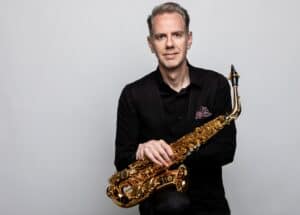
Photo by rrjones
About Timothy McAllister
Hailed by The New York Times as “one of the foremost saxophonists of his generation,” Timothy McAllister has premiered more than 300 works and appeared with leading orchestras and festivals worldwide.
Recent highlights include his New York Philharmonic debut performing John Corigliano’s Triathlon, a work he premiered with the San Francisco Symphony. He has also premiered concerti written for him by Adolphus Hailstork, Steven Mackey, James Lee III, Jennifer Higdon, Tyshawn Sorey, and John Adams. His performance of Adams’ Saxophone Concerto at the BBC Proms is among appearances in more than 20 countries.
McAllister’s discography includes more than 60 albums. His latest release, Project Encore Vol. 2, created with pianist Liz Ames, features new works by leading composers including Wynton Marsalis and Jennifer Higdon. With Ames and saxophonist Branford Marsalis, he also performs as the Marsalis-McAllister-Ames Trio.
A member of the Grammy Award-winning PRISM Quartet, McAllister has performed at Carnegie Hall, the Chamber Music Society of Lincoln Center, and throughout Latin America and China. He is Professor of Saxophone at the University of Michigan and distinguished faculty at Interlochen Center for the Arts.
For more information, visit timothymcallister.com.
Jack M. Champaigne Masterworks Series is proudly sponsored by