Contemporary composers have found inspiration in baroque music; baroque composers have written music that sounds ahead of its time. This concert will feature Lara Turner, principal cello, performing on baroque and modern cello in an eclectic program juxtaposing music from both time periods.
Program
Lara Turner, cello/baroque cello
Nicola Canzano, harpsichord
Rafa Prendergast, violin/baroque violin
Brian Kay, guitar/theorbo
Caroline SHAW
in manus tuas
ARCANGELO CORELLI
La Folia
FRIEDRICH GULDA
Menuett from Concerto for Cello and Wind Orchestra
JEAN-FÉRY REBEL
“Chaos” from Les Élémens
HEINRICH BIBER
Battalia
Intermission
GIOVANNI BATTISTA PERGOLESI
Presto from Sinfonia for Cello in F major
IGOR STRAVINSKY
Vivo from Pulcinella Suite
JEAN-PHILIPPE RAMEAU
La Poule
OTTORINO RESPIGHI
“La Gallina” from Gli Ucceli
Nicola CANZANO
Concerto for Violoncello and Strings
(World Premiere)
Composer Key: Composer names in ALL CAPS indicate deceased composers. Composer names in Title Case indicate living composers.
Calendar for Musician Voices: Baroque Reflections
A Note From Lara
To create a crossover concert juxtaposing early and contemporary classical music, performed on both baroque and modern instruments, has been a longtime interest of mine. Within a day of being asked to design today’s concert, I realized that the program already existed as fragments in my head and was waiting for this perfect opportunity to emerge as a unified concept. I first played Shaw’s in manus tuas on a concert of contemporary music performed on baroque instruments. Though written with modern cello in mind, the more intimate sound of the baroque cello adds an additional color to this piece’s introspective mood. When I first became familiar with Rebel’s “Chaos,”
I was blown away by its mysterious and jarring sounds. I had not realized that a composer could have envisioned music with such clashing harmonies almost 300 years ago! I was also surprised to discover that in Battalia, Biber used “modern” instrumental techniques such as snapping the strings against the fingerboard and hitting the strings with the stick of the bow. Ever since I studied Stravinsky in college, I have loved his ballet Pulcinella; as a child, I loved Nina, the only piece I knew by Pergolesi. It was a happy accident when I first learned Pergolesi’s cello sinfonia and discovered that Stravinsky had “borrowed” the last movement for Pulcinella. Having the forces to perform Pergolesi’s original composition back to back with Stravinsky’s orchestration is a rare and special treat! While performing with the Baroque Chamber Orchestra of Colorado a couple of years ago, I had the good fortune of working with Nicola Canzano in a concert including his own compositions in the Baroque style. As I was brainstorming possible repertoire for this program, I realized that a piece by Nicola would be a perfect addition. I am thrilled that the South Bend Symphony was able to commission him to write a brand new cello concerto to end today’s concert.
This concert is dedicated to Andor Toth, Jr., my cello professor at Oberlin, who was inadvertently responsible for introducing me to baroque cello. I am eternally grateful for his teaching of cello technique and musical awareness which have helped me to become the musician and teacher I am today.
About the Instruments
You may see some instruments on stage that are unfamiliar to you. The baroque cello is held with the legs instead of having an endpin anchoring it to the floor, and the baroque violin does not have a shoulder rest or chin rest. The sound of a baroque stringed instrument differs from that of its modern counterpart for several reasons: the strings are made from animal intestine (gut) and the instrument is under less tension, producing a softer and more earthy tone; the bow is lighter and more agile, creating a different kind of resonance and articulation in the sound; and vibrato is used sparingly as a decoration, in contrast to its almost constant presence in the modern string sound. The harpsichord is the predecessor to the piano, but its mechanism of sound production is completely different. The keys are connected to plectra which pluck the strings, as opposed to hammers that hit the strings inside the piano. The harpsichord’s sound is more similar to the guitar or harp than to the piano, and has a much softer sound. The theorbo does not have a modern equivalent. The largest member of the lute family, it is a pear-shaped plucked instrument with a body size similar to the guitar. It has an extremely long neck to accommodate long strings which make playing very low notes possible.
in manus tuas (2009)
Caroline Shaw
in manus tuas (into your hands) is based on an earlier motet, in this case that of Thomas Tallis. While there are only a few slices of the piece that reflect exact harmonic changes in Tallis’ setting, the motion (or lack of) is intended to capture the sensation of a single moment of hearing the motet in the particular and remarkable space of Christ Church in New Haven, Connecticut. in manus tuas was written in 2009 for cellist Hannah Collins, for a secular solo cello compline service held in the dark, candlelit nave.
— Caroline Shaw
La Folia (1700)
Arcangelo Corelli
The name La Folia means “madness” or “folly” in Italian, referring to the way peasants energetically danced to the music in its original form in the 15th Century. By the end of the 17th Century, La Folia had become incredibly popular, and many composers showed off their creativity by writing variations on this theme. Corelli’s version may be the most well-known today, thanks in part to Shinichi Suzuki, who included it in his violin method book.
Menuett from Concerto for
Cello and Wind Orchestra (1980)
Friedrich Gulda
Concerto for Cello and Wind Orchestra, an eclectic work consisting of a different musical genre for each of the five movements, was composed for the Austrian cellist Heinrich Schiff. The sweet and simple Menuett is reminiscent of a Baroque or Renaissance dance with the colorful addition of guitar and tambourine accompaniment.
“Chaos” from Les Élémens (1738)
Jean-Féry Rebel
“Chaos” is the first movement of a ballet depicting the creation of the world, and is divided into seven parts referring to the seven days of the creation of the world as described in Genesis. In the introduction to the first edition, Rebel warned his audience about what they would hear: “It was Chaos…which reigned between the Elements before the moment when [they were] subjected to invariable laws… [and] took the place which is prescribed to them in the order of nature. To designate…each element…I used the most popular conventions. The bass expresses the earth through notes linked together and which are played by jerks. The Flutes, by lines of song, which go up and down, imitate the course and the murmur of the water. The air is painted by outfits followed by cadences that form the small flutes. Finally, the violins, in lively
and brilliant lines, represent the activity of fire. These distinctive characters are recognized, separated or confused, in whole or in part…I hazarded to hear first all the sounds mixed together or rather all the notes of the Octave united in a single sound.”
Battalia (1673)
Heinrich Ignaz Franz Biber
In Battalia (Battle), a programmatic work depicting various stages of a battle, Biber experimented with innovative musical ideas and extended playing techniques. In “The Disorderly Company with Much Good Cheer,” multiple folk songs are played simultaneously, creating the raucous sound of a busy night at the pub. Biber instructs the bass players to weave paper through their strings to create a snare drum effect when hit with the bow in “The March.” In “The Battle,” the bass players use snap pizzicato, a technique made famous by 20th Century composer Béla Bartók, when the string is pulled away from the fingerboard and released to create a loud snapping sound.
Presto from Sinfonia for
Cello in F major (1734/35)
Giovanni Battista Pergolesi
It is believed that Pergolesi wrote the cello sinfonia for his patron, an amateur cellist. Presto is the fourth and final movement of this work. Being familiar with Stravinsky’s better-known adaptation of this movement in Pulcinella creates the challenge of hearing this original Baroque composition on its own terms!
Vivo from Pulcinella Suite (1920)
Igor Stravinsky
Stravinsky was introduced to music by Pergolesi when his collaborator, the choreographer Sergei Diaghilev, asked him to arrange it for his ballet, Pulcinella. Stravinsky’s orchestration of Pergolesi’s Presto heavily features trombone and bass, making it more comical and completely changing the feel of the original piece.
La Poule (1726-27)
Jean-Philippe Rameau
La Poule (The Hen) is a humorous, programmatic piece for solo harpsichord depicting a clucking chicken. To clarify the sound Rameau had in mind, he wrote the syllables “co co co co co coco dai” under the opening musical notes.
“La Gallina” from Gli uccelli (1928)
Ottorino Respighi
Respighi was interested in early music, and used it as a source of inspiration in many of his compositions. The third movement of his suite, Gli uccelli (The Birds), is his reimagined, colorful version of Rameau’s solo harpsichord piece,
La Poule.
Concerto for Violoncello and Strings (2026)
Nicola Canzano
This concerto was a joy to write and it’s been a true pleasure working with Lara on it. The piece does not attempt to embody some sort of grand symbolism. It’s not “about” anything. There is no cute story that led to its creation — it was commissioned, and I wrote it. This is the boring story behind a great many of our most cherished pieces of music. Sometimes, one is inspired only after a few notes have already been written. Composers were artisans getting a job done long before they were the tortured brooding souls spinning their lives and emotions into their work, a strange and largely made-up romanticization of the “artist” born in the 19th Century which lives on today.
I don’t believe that good music is any less good if it lacks these accouterments that we’ve become accustomed to due to the proliferation of program notes. I think good music touches the heart, in any of the myriad ways that’s possible, and it should be easily understood on a first listen. I believe good music tells a story, even when the composer hasn’t tried to translate one that could be said in words. I don’t believe good music needs to challenge the audience, nor do I believe it needs to be perfectly digestible like a saltine cracker. I’ve tried my very best to make this concerto well-wrought and lovingly constructed, but more importantly a pleasure to experience—for classical music veterans, or for someone completely random off the street. The first movement is a party, the second movement is a letter filled with hope, and the third is…well, the third movement is a fugue. If a little of the love I have for music and the joy I felt writing these movements rubs off even for a second, I’ll consider that a grand success…!
— Nicola Canzano
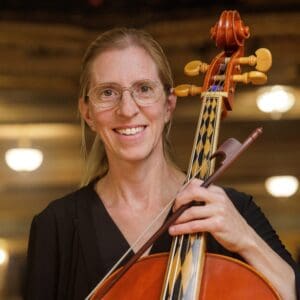
An active performer on cello, baroque cello, and viola da gamba, Lara Turner enjoys a varied career performing music ranging from contemporary to baroque.
Lara has held the position of Principal Cello with the South Bend Symphony since 2004. She has been a featured soloist with the symphony performing Milhaud’s Concerto No. 1, Tchaikovsky’s Variations on a Rococo Theme, Saint-Saens’ Concerto No. 1, Beethoven’s Triple Concerto, and most recently, the first movement of Haydn’s Concerto No.1 in Alastair Presents: Seeking Haydn. As a chamber musician, Lara is a member of Claricello, a clarinet and cello duo co-founded with her husband, Jason Gresl, focusing primarily on contemporary classical music written for this unusual combination. They have performed in Canada, Italy, Holland, Ireland, and across the United States, and their performance of “Dust” by Belinda Reynolds can be heard on her CD, Cover.
Passionate about performing early music on period instruments, Lara has been the principal cellist of the Baroque Chamber Orchestra of Colorado since it was founded in 2005. She is a core member of the Indianapolis Baroque Orchestra and was the principal cellist of Bourbon Baroque (Louisville, KY) for 13 years until the group disbanded in 2023. In addition, Lara has been a featured soloist on viola da gamba in Bach’s St. Matthew Passion at the Baldwin Wallace Bach Festival, and has frequently performed with other early music ensembles including Fort Wayne Bach Collegium, NYS Baroque, Three Notch’d Road, and North Carolina Baroque Orchestra.
A dedicated teacher, Lara has enjoyed many opportunities both in the United States and abroad. She has taught cello lessons and coached chamber music ensembles at the National Music Camp for Youth in Panama and as part of a Fulbright project in Bolivia. Currently, she maintains private cello studios in South Bend and Berrien Springs, serves as adjunct cello faculty at Saint Mary’s College and Andrews University, and coaches Fischoff Chamber Music Academy ensembles and the cello section of the South Bend Youth Symphony.
Lara holds a Bachelor of Music degree from the Oberlin Conservatory where she studied with Andor Toth, Jr. and Catharina Meints. At the San Francisco Conservatory she earned a Master of Music degree studying with Bonnie Hampton.
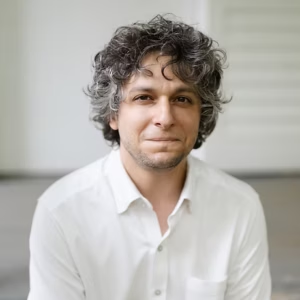
Nicola Canzano is a composer, harpsichordist and organist recognized for his expertise in historical composition and improvisation. His compositions in baroque style have been commissioned and performed by groups all over the world, including the musicians at Thiré, the Baroque Chamber Orchestra of Denver, Juilliard415, as well as many individual performers. While a student at Juilliard in 2021, Nicola founded Nuova Pratica, a period ensemble which composes all of its own repertoire, with his classmates. He can still be found at Juilliard where he teaches a course on improvisation and plays as studio accompanist for Historical Performance. Nicola was adjunct faculty (harpsichord) at Michigan State University from 2022-25 and a panelist at the First International Conference on Historical Improvisation in 2022. He teaches improvisation and composition privately in New York City where he resides, and maintains a busy performance schedule as a continuo player with ensembles throughout the US, most recently joining the Musicians of the Old Post Road based in Boston, as well as presenting on improvisation and pedagogy at universities both at home and abroad. Nicola has a little beagle-mix named Riley which is his greatest pride and joy.
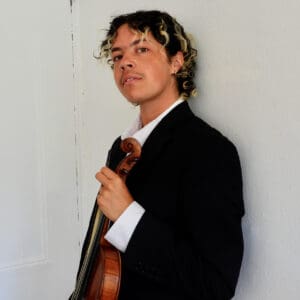
Brooklyn based violinist Rafa Prendergast is an active performer of works dating from the early 17th century through the present day. Rafa is a guest concertmaster with the Baroque Chamber Orchestra of Colorado, and performs frequently with Handel and Haydn Society, Twelfth Night, Theotokos, Nuova Pratica, New York Baroque Incorporated, and ARTEK, among many others.
Rafa was featured in a social media campaign for ABC’s The Bachelor. Residencies and visiting Guest Artist engagements include Avaloch Farm Music Institute, the University of Michigan’s School of Music, and Michigan State University. Rafa has performed as part of Carnegie Hall’s Well-Being Concerts, Death of Classical series, Boston Early Music Fringe Festival, Aston Magna Music Festival, and WQXR’s Midday Masterpieces series.
Rafa holds a Bachelor of Music Degree from Vanderbilt University’s Blair School of Music, and a Master of Music Degree from The Juilliard School where he was a recipient of the full tuition Historical Performance Scholarship.
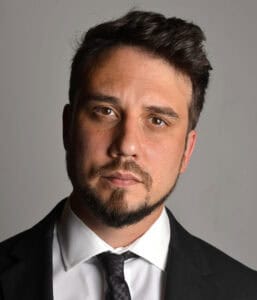
Brian Kay is a modern-day troubadour. He is the Artistic Director of the early music meets early theater group THEATRO, and oversaw their international recording of music from the plays of William Shakespeare. He won a GRAMMY® Award for his work on Apollo’s Fire’s Songs of Orpheus album. He works as a recording artist for the Netflix music lab and is a featured soloist on the soundtrack of their original series The Witcher and The Decameron. He also created arrangements of Russian folk songs for their upcoming Guillermo del Toro film Frankenstein. He has performed throughout the world at venues such as the National Concert Hall of Dublin, Belfast Castle (Ireland), Carnegie Hall, the Kennedy Center, and the Folger Theater. His live radio appearances include NPR, Baltimore’s WYPR, Baltimore’s 98ROCK, Boston’s WGBH, and Cleveland’s WCLV. He has recorded with labels Avie and Sono Luminus and has appeared on releases which include original, early music, folk, traditional sephardic, chamber and orchestral. He is a multi-instrumentalist, songwriter, arranger, and a traditional and historical music specialist.
Brian is a founding member of THEATRO and Twa Corbies, and regularly performs with Hesperus, The Folger Consort, Early Music Access Project, and Trio Sefardi.
Brian is on the faculty as teacher of historical plucked instruments at Cleveland Institute of Music and Case Western Reserve University. He has lectured on music and history at Yale University, The Peabody Conservatory, Johns Hopkins University, The Folger Theater, The Kennedy Center, and Baldwin-Wallace College. He was Artist in Residence at the Cushman School in Miami and has done outreach for elementary schools, middle schools, high schools, colleges, and prisons across the country.
Can’t make it to a Mosaic concert in person? Tune in to 88.9 WSND-FM for the rebroadcast of Musician Voices: Baroque Reflections. Listen on Sunday, January 24 at 2:00 p.m., and experience the music from wherever you are!
The June H. Edwards Mosaic Series is proudly sponsored by
DeBartolo Performing Arts Center
100 Performing Arts Center
University of Notre Dame
South Bend, IN 46556-4600