
February 28, 2026 / 7:30 p.m.
South Bend Symphony Concertmaster Jameson Cooper takes center stage as the Symphony presents Beethoven’s Eroica—a revolutionary masterpiece of heroism, resilience, and triumph.
Program
Jessica CARTER
Hidden: In memory of Rosemary Sanders
MAX BRUCH
Concerto No. 1 in G minor for Violin and Orchestra, Op. 26
I. Prelude: Allegro moderato
II. Adagio
III. Finale: Allegro energico
— Intermission —
LUDWIG VAN BEETHOVEN
Symphony No. 3 in E-flat major, Op. 55 “Eroica”
I. Allegro con brio
II. Marcia funebre: Adagio assai
III. Scherzo: Allegro vivace
IV. Finale
Program Notes
Hidden: In memory of Rosemary Sanders
Jessica T. CARTER
Born: 1992
Composed: 2025
World Premiere
Jessica T. Carter is a composer, violinist, mezzo-soprano, and educator from Indiana whose music has been described as “evocative” (Aspire Magazine) and “lyrical” (Apricity Magazine). Her work explores the intersection of empathy, compassion, and disruption, often amplifying marginalized voices through story-driven soundscapes. Carter is the recipient of the Craig and Carol Kapson Bicentennial Scholarship in Music Composition (2018, 2019), winner of the 2020 Indiana University South Bend Symphonic Composition Competition with her cello concerto Rancor and Triumph, a 2023 finalist for the Respighi Prize in Composition, and a 2025 finalist for the American Prize in Composition. Her works have been commissioned by the South Bend Symphony Orchestra, Crossing Borders Music, Castle of Our Skins, and Ensemble CONCEPT/21. Her research and creative output include Concert Music of the Civil Rights Movement (2020 and her debut “EP Memories” (2020).
Concerto No. 1 in
G minor for Violin and Orchestra, Op. 26
Max Bruch
Born: January 6, 1838, Cologne, Prussia
Died: October 2, 1920, Berlin-Friedenau, Germany
Composed: 1866; revised 1867
Premiered: January 7, 1868, Bremen, Germany, with Joseph Joachim as soloist and Karl Martin Rheinthaler conducting
Duration: 25 minutes
Having completed his first symphony by age 14, Max Bruch displayed an early aptitude for music under the tutelage of his mother and was seemingly heading to a bright future as a composer or conductor. By all accounts, he achieved this in his lifetime, but in modern times, he has been characterized as a composer overshadowed by peers such as Johannes Brahms.
Modern selections from Bruch’s compositional output are generally limited to just three pieces: His Scottish Fantasy for violin and orchestra, Kol Nidrei for cello and orchestra, and the Violin Concerto No.1, which you will hear on this program. In its time, the concerto was so popular that Bruch himself began even to despise it. In response to excessive requests to perform it by violinists, the composer said the following in a letter to a friend: “Every fortnight, another one comes to me wanting to play the first concerto. I have now become rude, and have told them: ‘I cannot listen to this concerto anymore, did I perhaps write just this one? Go away once and for all, play the other concertos, which are just as good, if not better.” Despite this personal dissatisfaction with the work’s success, the work was not immediately the hit it became. The work initially premiered in 1866, but Bruch was dissatisfied with it and sent it to several colleagues for revisions. The most notable and lasting revision came from violinist Joseph Joachim, who provided a comprehensive list of changes and gave the premiere of the improved work in 1868.
Structurally, the concerto unfolds in three movements with the opening “Vorspiel: Allegro moderato” serving as a prelude, eschewing traditional exposition in favor of a quasi-rhapsodic dialogue between soloist and orchestra. This leads directly into the “Adagio,” the heart of the concerto, where the violin sings with poignant expressiveness over a rich orchestral accompaniment. The finale, “Allegro energico,” bursts forth with speed and spirited themes, culminating in a dazzling display of the performer’s virtuosity.
Bruch’s concerto is notable for its blend of classical form and Romantic expressiveness. Its everlasting appeal is a testament to its melodic richness and the emotional resonance it continues to evoke in performers and audiences alike. Despite Bruch’s own frustrations over its overshadowing of his other works, this concerto’s genius is undeniable.
Symphony No. 3 in E-flat major, Op. 55, “Eroica”
Ludwig van Beethoven
Born: December 17, 1770, Bonn, Germany
Died: March 26, 1827, Vienna, Austria
Composed: 1803–1804
Premiered: April 7, 1805,
Theater an der Wien, Vienna
Duration: 50 minutes
Few works in the orchestral canon have redefined Western music as profoundly as Beethoven’s “Eroica” Symphony. Beethoven originally dedicated the piece to Napoleon Bonaparte as a symbol of heroic ideals. However, after learning Napoleon had declared himself Emperor, Beethoven famously rescinded the dedication. He instead inscribed the work as “Sinfonia eroica, composed to celebrate the memory of a great man.” The title “Eroica,” or “heroic,” remained, now serving as a more abstract tribute to heroism itself. Completed in 1803 and premiered two years later, Symphony No. 3 marked a turning point. This change was not only in Beethoven’s own career but also in the symphonic tradition.
From its opening chords, the “Eroica” declares a bold and exciting musical language. The first movement, Allegro con brio, bursts with energy and emotional range. Its thematic development was unprecedented in earlier symphonies. Beethoven stretches the boundaries of form and harmony. He crafts a movement filled with ambition and narrative scope. The second movement is a solemn funeral march. This offers stark and introspective contrast, inviting listeners into a meditation on loss and mortality. The Adagio assai would later be played at memorial events for figures such as Felix Mendelssohn and Franklin D. Roosevelt.
The third movement, Scherzo, brings back vigor and playfulness. Its rhythmic vitality and unexpected accents show Beethoven’s inventive use of orchestral color. The finale uses a theme and variations structure. It builds on material from his earlier ballet, The Creatures of Prometheus, and ends in a brilliant and exuberant conclusion. Beethoven challenges listeners with abrupt shifts and extended development sections. The expressive scale decisively breaks from Classical restraint.
In the “Eroica”, Beethoven not only expanded the symphony’s length and complexity through its intricate thematic development and bold harmonic progressions, but also infused it with a psychological and philosophical depth that set the stage for Romanticism as a musical movement. It is a work of revolution, not only in its political and cultural allusions at the time but in its fearless reimagining of what orchestral music could express.
About Jameson Cooper
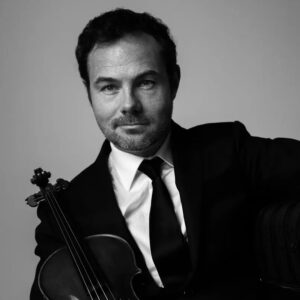
Jameson Cooper is a multi-faceted performer and teacher from Sheffield, England. He first gained national attention as Concertmaster of the National Youth Chamber Orchestra for its BBC Proms debut. After graduating from the Royal Northern College of Music, he moved to the United States to study violin with Dorothy DeLay and Roland and Almita Vamos. A founding member of the Euclid Quartet, he has won major competition prizes and performed widely, including at Carnegie Hall, the Library of Congress, and as a soloist in leading European and United States halls such as the Kennedy Center. With the Euclid Quartet, Mr. Cooper serves as Artist in Residence at Indiana University South Bend; the ensemble received an NEA American Masterpieces grant for its innovative education work. His discography spans contemporary solo works written for him; Euclid’s complete Bartók quartets plus Kauder, Dvořák, and Marsalis (with Grieg and Debussy forthcoming); and recent solo releases of Prokofiev, Respighi, French sonatas, and Spohr duos. In 2023, he became Concertmaster of the South Bend Symphony Orchestra.
www.jamesoncooperviolin.com
Meet the Musicians Here!
Sponsors