January 11, 2026 / 2:30 p.m.
Handel’s brilliance meets Jennet and Friends! Principal Oboist Jennet Ingle walks us through the work of Handel, Morricone, Stacy Garrop and a world premiere concerto by Kincaid Rabb with guest conductor Fernanda Lastra!
Program
GEORGE FRIDERIC HANDEL
“Entrance of the Queen of Sheba”
Water Music Suite No. 2
Stacy GARROP
Spectacle of Light
Kincaid RABB
“All This to Say” for Solo Oboe and Chamber Orchestra
Heather NIEMI SAVAGE
Daughter of the Stars
Esteban BENZECRY
Obertura Tanguera, homenaje a Astor Piazzolla
Program Notes
“Entrance of the
Queen of Sheba”
GEORGE FRIDERIC HANDEL
Born: March 5, 1685, Halle, Germany
Died: April 14, 1759, London, England
Composed: 1749
Duration: 3 minutes
Trained in Italy, George Frideric Handel settled in London and first gained work composing Italian opera. When tastes shifted in the 1730s, he pivoted to the English oratorio: a concert work based on biblical subjects, performed without staging or scenery, with chorus and orchestra to the fore. These works were cheaper to produce, easier to tour, and proved to be more lucrative than opera had ever been. Solomon (1749), from which “The Entrance of the Queen of Sheba” is drawn, stands as a vivid example of the form. Set to Newburgh Hamilton’s libretto and based the books of Kings and Chronicles, it portrays Solomon’s reign in scenes of pious dedication, pastoral calm, and civic splendor.
The “Entrance of the Queen of Sheba,” opens Act III as the visiting monarch and her retinue arrive at Solomon’s court. Handel sets the procession as a bright, quick-stepping sinfonia in B-flat major, led by two oboes in playful dialogue over buoyant strings and continuo. This movement has enjoyed an enduring popularity that has overshadowed Solomon itself and is often heard at weddings and receptions across the globe. Most recently, this work was featured in the opening ceremonies of the 2012 London Olympics and at the coronation of King Charles III in 2023.
Water Music Suite No. 2
Composed: 1717
Duration: 12 minutes
Handel’s Water Music Suite No. 2 was designed for outdoor display and royal delight. On the evening of July 19, 1717, King George I took to the Thames in an open barge, trailed by a separate musicians’ barge playing a new set of “symphonies” composed for the occasion. A contemporary report says the King enjoyed the music so much he had it performed three times over the course of the outing. What we now call Water Music survives not as a single score but as three related suites in F, D, and G respectively. Each of these suites are tailored to different instrument groups and were likely used in different moments of the festivities. The D-major suite is the most brilliant of the three, adding natural trumpets and horns to the oboes, bassoon, strings, and continuo. Exactly the kind of bright, projecting sonority that carries across water.
“All This to Say” for Solo Oboe and Chamber Orchestra
Kincaid RABB
Born: 1993
Composed: 2024–25
I first met Jennet Ingle in an elevator while checking out of a hotel for the 2022 International Double Reed Society conference in Boulder, Colorado. We exchanged business cards, a few short sentences, and a smile. After the conference was over, I set up a Zoom call with Jennet, recognizing that we had not fully had the chance to talk with one another, and in that Zoom call, we realized who we had met in each other, as well as walking out with the first of several successful projects and collaborations: our intermediate concert etude book Epiphanies.
Within each conversation I have with Jennet, we have a topic but get easily distracted, making points and counterpoints, tangents effortlessly unfurling with enthusiasm, laughter, and profound discovery. I remember the first time Jennet had wrapped up one of our conversations with the simple preamble from which I took the title and inspiration for her concerto: “All This to Say…”
“‘All This to Say’ is more than a concerto; it is a celebration of my closest relationship with any performer in the world, Jennet Ingle.” She is fearless, passionate, honest, and, in a lot of ways, a huge role model for me. She and I share many things: an obsession with process, a healthy dose of sarcasm, a willingness to experiment, and a thirst for knowledge. This concerto is structured in three movements that reflect the envelope of a conversation with Jennet: first, the topic, shrouded in uncertainty; second, the exhilarating tangent; and third, the summary of the conversation itself, finally ending on a punctuating, profound exclamation. All This to Say is metacommentary turned music, a collaborative process immortalized, and the cumulation of every emotion I have felt because of my dear friend and collaborator Jennet Ingle.
– Kincaid Rabb
Spectacle of Light
Stacy Garrop
Born: 1969, Chicago, Illinois
Composed: 2021
Duration: 8 minutes
When Music of the Baroque commissioned me to compose a piece in honor of their 50th anniversary season, I was delighted that my new piece would premiere on a concert entitled Baroque Fireworks. But what aspect of Baroque fireworks should I explore? I found the answer on Music of the Baroque’s website. In perusing the webpage for the Baroque Fireworks concert, I was mesmerized by the page’s backdrop image, which looked to be a hand-drawn picture of a fireworks show. A little research uncovered that the image is an etching of a 1749 fireworks spectacle that took place on the River Thames in honor of Great Britain’s King George II. The king had signed the 1748 treaty at Aix-la-Chapelle that officially ended the War of Austrian Succession, and as was typical in this era, he wanted to celebrate with a grand show of music and fireworks. This is the very same event for which George Frideric Handel wrote Music for the Royal Fireworks.
I was intrigued by the manner in which the etching’s artist represented the path of each individual firework, starting with an upward trajectory of a golden streak of light that inevitably bends and falls back towards the earth, blooming into glittering specks before flickering out. This inspired me to find other depictions and etchings of Baroque fireworks, as well as to view numerous modern-day fireworks shows on YouTube to study how they rise, bloom, and overlap with each other to create a rich, complex, and fleeting tapestry of color. I realized that fireworks and music share an ephemeral nature: they both delight our senses before fading into memory.
Ultimately, I decided that Spectacle of Light would represent the experience of a fireworks show. The music starts with great anticipation as the crowd waits in darkness, then a single firework illuminates the sky, followed by a massive eruption of light, color, and sound. After this initial frenzied burst, the fireworks quiet down into a slower-paced, mesmerizing display of colors before building to a big, fiery ending. As a tip of the hat to Music of the Baroque, I worked a few salient elements of the baroque style into my own musical language, as well as found a few choice spots to add a few subtle hints of Handel’s Royal Fireworks.
– Stacy Garrop
Daughter of the Stars
Heather Niemi SAVAGE
Born: 1974
Composed: 2018
Duration: 5 minutes
Inspired by the American folk tune, “Shenandoah”, (the word meaning “spruce stream, great plains, beautiful daughter of the stars”), “Daughter of the Stars” suggests the ambiguous origins of the folk tune: a sea shanty; a song sung by fur traders; a song originating with slaves (perhaps the lyrics “across the wide Missouri” were originally “across this world o’ mis’ry.”) Incorporating a wide span of emotion, “Daughter of the Stars” takes the listener on a journey down a musical river filled with wonder and anticipation, conflict and turbulence, melancholy and longing, hope and serenity.
– Heather Niemi Savage
Obertura Tanguera, homenaje a Astor Piazzolla
Esteban Benzecry
Born: 1970, Lisbon, Portugal
Composed: 1993
Premiered: 1995, Orquesta Sinfónica Carlos Chávez, Mexico
Duration: 7 minutes
This piece was commissioned by the National Youth Choir and Orchestra of Mexico. The premiere took place two years later by the “Carlos Chávez” Symphony Orchestra, under the direction of Maestro Fernando Lozano. The name of Obertura Tanguera refers to the melodic and rhythmic turns of tango in its most modern expression, constituting a tribute to Astor Piazzolla who had died a few months before beginning to compose it. The work has a tripartite structure, with a short introduction that leads to a fast theme, a central section of a slow and expressive theme played by the strings, which go in crescendo until the re-exposition of the fast theme, reaching its climax at the end.
– Esteban Benzecry
About Jennet Ingle
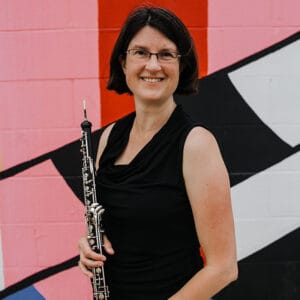
Jennet Ingle has been Principal Oboist of the South Bend Symphony Orchestra since 2006. Jennet is a soloist at heart, joyfully taking over any stage that will have her.
As the owner and operator of Jennet Ingle Reeds, she makes and sells over two hundred handmade reeds every month, and helps oboists with their own reed-making through her YouTube series, The Five Minute Reedmaker, her weekly online Reed Club, and her beginner course, Zero to Reedmaker.
She encourages musicians to thrive in their creative careers with her podcast, Crushing Classical, her book, The Happiest Musician, and 1:1 business and mindset coaching.
Jennet can be found on the web at www.jennetingle.com.
Photo by: Hemlock and Lace Photography
About Fernanda Lastra, Guest Conductor
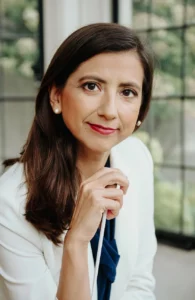
Born in Mar del Plata, Argentina, Fernanda Lastra is a passionate and creative conductor, recognized for her artistic leadership and captivating performances. Deeply committed to fostering music appreciation across all ages, she designs well-balanced programs that enrich the concert experience, guided by her belief in the power of music to unite, heal, and nurture emotional intelligence. Equally devoted to building meaningful connections within the community, she strives to create a vibrant musical legacy for future generations. Lastra is also a dedicated advocate for Latin American composers, with a special focus on preserving and promoting Argentina’s musical heritage.
About Kincaid Rabb, Guest Composer

Kincaid Rabb is a musicmaker, writer, storyteller, pedagogue, and tyrannosaurus rex. Kincaid creates music for waders, swimmers, and divers alike, each new work an invitation to go on an adventure. A lifelong learner and advocate for continuing education, Kincaid specializes in teaching beginning composers of all ages. Kincaid writes poetry, nonfiction, short stories, fanfiction, and the occasional long-winded blog post. Kincaid holds degrees from the University of Arizona and the University of Nevada, Las Vegas, and their principal teachers include Douglas Harbin, Daniel Asia, Pamela Decker, Jennifer Bellor, and Jennifer Jolley.
Kincaid’s works are exclusively published by Trevco Music. Kincaid lives in Las Vegas, Nevada with their partner, their dogs, and an unreasonable amount of Magic: the Gathering cards.
Meet the Musicians Here!
Sponsors